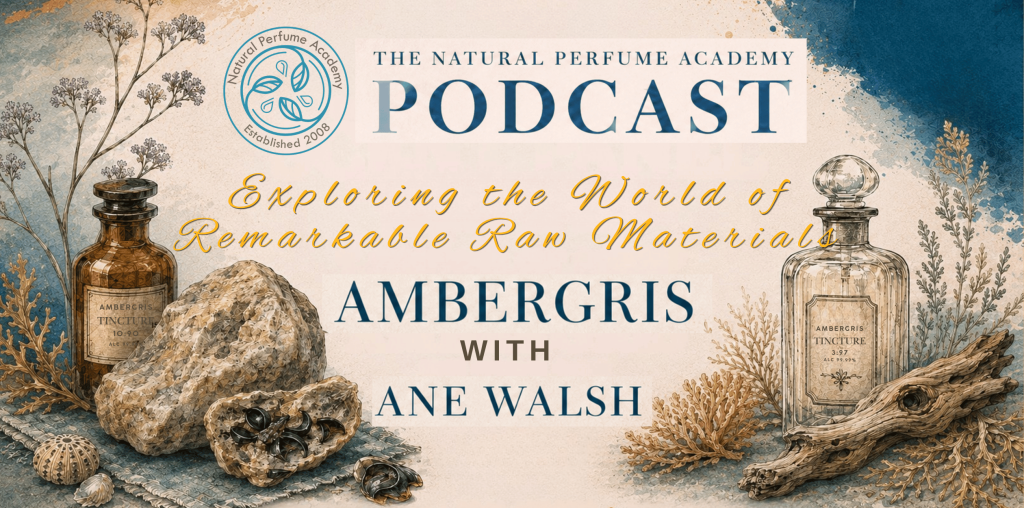
Ambergris in Perfumery | Scent Panel Ep. 2 with Ane Walsh

Ambergris in perfumery is one of the most fascinating, mysterious and misunderstood subjects in the scent world. In Episode 2 of the Natural Perfume Academy Scent Panel, Ruth Ruane and Ane Walsh explore what real ambergris smells like, how it changes with age, and why even a minute quantity can bring depth, movement and life to a perfume.
Ambergris in Perfumery: What This Episode Explores
In the second episode of our Scent Panel series, Ruth and Ane dive deeply into one of natural perfumery’s rarest and most legendary materials: ambergris.
Ambergris can be difficult to describe because its odour changes according to its age, colour, origin and dilution. It may smell marine, salty, animalic, musky, waxy, soapy, leathery or powdery. It can recall warm skin, sea air, algae, tobacco, old polished wood, sweet hay, church pews or sun-warmed driftwood.
This conversation explores:
• What ambergris is and how it forms
• Why its formation is sometimes compared to the creation of a pearl
• Black, beige and white ambergris, and how ageing changes its character
• The hot-needle test and how genuine ambergris behaves when heated
• Why ambergris may smell marine, salty, animalic, soapy, musky or like warm skin
• Ambergris tinctures and why even faint dilutions can transform a perfume
• How ambergris exalts, anchors and gives movement to a composition
• Why tiny amounts can make such a dramatic difference
• The relationship between ambergris, florals, orris and other base materials
• Ambroxan and synthetic ambergris-style notes in modern perfumery
• Beachcombing, storms, trained dogs and the search for ambergris
• Why perfumers value whole, intact pieces
• The importance of smelling genuine raw materials before judging substitutes or suppliers
What Does Real Ambergris Smell Like?
There is no single correct answer.
One of the most revealing parts of this episode is the way Ruth and Ane describe ambergris through memory and association rather than through a fixed list of recognised perfume notes.
Their conversation moves through sea air, salted skin, old soap, algae, tobacco, leather, powder, warm driftwood and aged church wood. Ane offers one particularly unforgettable description that combines femininity, clean skin, the sea and the scent of clothing worn for a day.
Black or more recently formed ambergris may be intensely animalic. As the material ages and becomes paler, it can lose much of that initial pungency and develop a softer, sweeter, cleaner and more marine character.
That natural variation is one reason ambergris in perfumery cannot be properly understood through written descriptions alone. It has to be smelled, compared and revisited over time.
Tincturing and Using Ambergris
Ane explains how she prepares a very light ambergris tincture and uses it as part of the alcohol base of a perfume. The tincture may initially appear almost odourless, yet it can give the finished composition expansion, depth, presence and movement.
Ruth describes using little more than a scraped grain of ambergris in a solid perfume. Even in that minute quantity, the material gradually began to take ownership of the composition.
Both perfumers warn that restraint is essential. Ambergris develops with time. A blend that seems beautifully balanced during its first week may change as the ambergris grows stronger and begins to engulf the other materials.
Like orris, ambergris asks for patience, careful dilution and repeated evaluation.
Finding and Identifying Ambergris
The episode also explores the practical world of ambergris hunting.
Ruth recalls advice shared by an Irish ambergris hunter about searching after large storms, looking well above the ordinary shoreline and watching for areas where ocean debris has been deposited. Trained dogs can recognise the scent, while the traditional hot-needle test may help distinguish genuine ambergris from ordinary stones, wax or other beach material.
Listeners are also reminded that laws governing ambergris differ between countries. Anyone who finds, buys or sells it should check the rules that apply in their own location.
More Than a Fixative
Ambergris in perfumery is not merely a scent or a background fixative. Used carefully, it can animate a composition without announcing itself as an obvious note.
It can bring delicate floral materials forward rather than weighing them down. It can anchor a perfume while still allowing it to breathe. It can add radiance, sensuality and an almost invisible sense of movement.
Along the way, Ane shares her practical experience of tincturing and blending with ambergris, while Ruth explores the strange poetry of a material shaped by the sea, time and transformation.
This is a slow, thoughtful and sometimes very funny conversation about scent memory, animalic materials, rare ingredients, artistic instinct and why some perfume materials are felt as much as they are smelled.
LINKS & PROJECTS MENTIONED
“Notas da Perfumista” by Ane Walsh
Sunday Readings / Portuguese Reading Archive
Advanced Perfumery Workshops – Portuguese Pilot Offer
(Available until 21 June)
Juliana’s “Build Your Artisan Business Online” Course
NPA Certified Perfumers Directory
Celtic Ambergris Reputable Suppliers
AbdesSalaam Italy – Reputable Suppliers
If you enjoyed this episode and would like to hear more Scent Panels exploring individual raw materials, leave a comment and let us know what material we should discuss next.
Possible future episodes:
Vetiver • Rose • Oakmoss • Jasmine • Lavender • Boronia • Tuberose • Cinnamon • Resins • Tinctures